
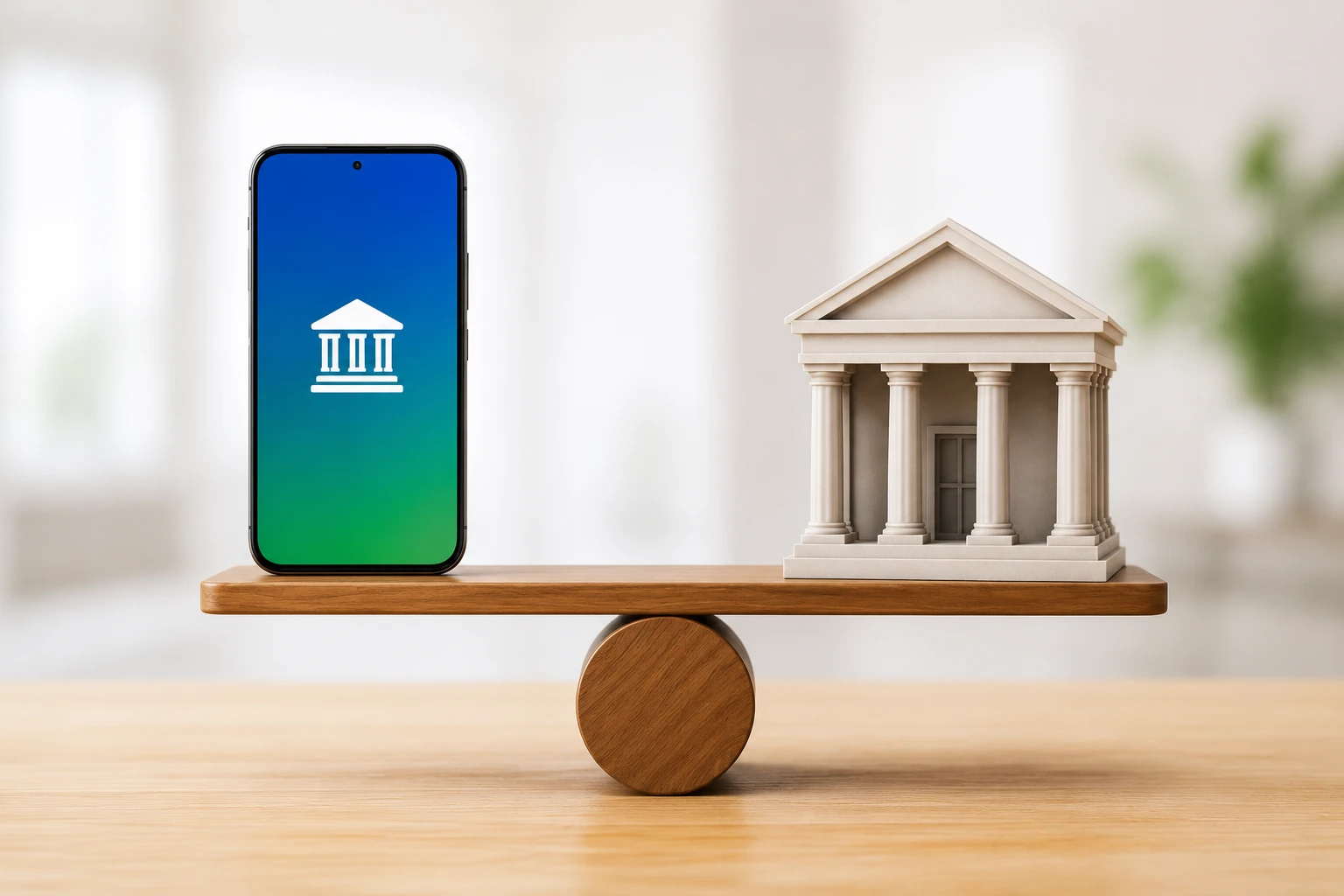
20 years ago, opening a bank account required waiting in line, completing paperwork, and waiting days for approval. You can now open a full financial account from your phone in less than 5 minutes, without visiting a branch. That change is central to the fintech vs. traditional banking debate and is reshaping how billions of people handle their money.
The global fintech market is expected to grow to approximately USD 460.76 billion by 2026 with a steady growth rate. However, traditional banks did not vanish in many respects; they are adapting, collaborating with fintech firms, and competing more than ever. So, which one works best for you? This guide explains the differences between fintech and traditional banking, the strengths of each, and how to determine which is best for you.
TL;DR
- Fintech companies use technology-first platforms to deliver financial services often faster, cheaper, and more flexible than banks, but usually with a narrower range of products.
- Traditional banks offer full-service, heavily regulated financial products backed by physical branches, decades of trust, and (in most countries) government-insured deposits.
- The biggest differences lie in technology, cost structure, regulation, customer experience, and product range.
- Fintech companies typically make money through transaction fees, subscriptions, interest spreads, or data/API licensing, not branch-based interest margins.
- Many people now use both a traditional bank for savings and mortgages and fintech apps for budgeting, payments, or investing.
- The future isn’t “fintech vs banking” it’s collaboration through models like open banking and embedded finance.
What Is Traditional Banking?
Traditional banking is the financial services offered by traditional financial institutions, such as commercial banks, credit unions, and savings institutions, which usually have physical branches and also offer online and mobile banking services in recent years. They are well-regulated, insured (such as by the FDIC in the United States), and offer a wide range of services, including checking and savings accounts, mortgages, business loans, credit cards, and wealth management services.
They generate the majority of their revenue from the difference between the interest they receive from depositors and the interest they charge borrowers, account fees, and interchange fees.
What Is Fintech?
Fintech, or financial technology, refers to a range of companies that provide financial services through software, APIs, and data, and in some cases, without any physical branches. This encompasses digital wallets, neobanks, peer-to-peer payment apps, robo-advisors, buy now, pay later (BNPL) platforms, and lending platforms.
Fintech firms can be either fully licensed digital banks or non-bank startups that work with a licensed bank in the background to legally hold customer funds. That distinction is important, and it’s also the difference between a neobank and fintech: A neobank is a fintech company that provides banking services (accounts, cards, transfers, etc.) via a digital-only platform, whereas “fintech” is the category that encompasses payments, lending, investing, insurance, and more.
Fintech vs Traditional Banking: Key Differences
| Factor | Traditional Banking | Fintech |
|---|---|---|
| Infrastructure | Physical branches + legacy core banking systems | Cloud-based platforms, mobile-first apps |
| Speed of onboarding | Days (paperwork, in-branch visits) | Minutes (digital KYC, instant approval) |
| Product range | Broad loans, mortgages, wealth management, and business banking | Narrower, but deep in specific niches (payments, lending, investing) |
| Regulation | Heavily regulated, deposit insurance in most cases | Varies regulated directly or via bank partnerships |
| Cost structure | Often higher fees, minimum balance requirements | Typically lower fees, transparent pricing |
| Customer experience | Relationship-based, in-person support | App-based, chat/AI support, self-service |
| Innovation speed | Slower due to legacy systems and compliance layers | Faster iteration, frequent feature updates |
| Trust & longevity | Decades (sometimes centuries) of track record | Newer, still building long-term trust |
How Does Fintech Actually Make Money?
This is one of the most frequently asked questions, as many fintech apps appear to be free at first glance. In fact, there are several ways for fintech companies to generate revenue:
- The small percentage that banks and card networks pay fintech companies when their debit/credit cards are used.
- Subscription Fees: Higher-tiered options with extra features (typical of budgeting and investing apps)
- Interest Rate Spreads: Interest on deposits in partner banks, like conventional banks;
- Transaction Fees: Applied to transfers, currency conversion, or payment processing.
- Lending Margins: Interest rates on loans, credit lines, or BNPL installments
- API/Financial Infrastructure: Fees paid to other companies for using their financial infrastructure (the backbone of “banking-as-a-service”)
An example of this is buy now, pay later. BNPL companies typically make money from merchant fees, not the consumer, so the products are often presented as “interest-free,” but there are merchant cost pass-throughs that should be understood before using this payment method, and late fees.
Where Fintech Has the Edge
- Speed: Opening an account, loan approval, and international transfers occur in minutes, not days.
- Accessibility: Fintech has greatly increased financial access for those who are not served by traditional financial institutions, especially in emerging markets.
- Reduced fees: Many fintech products have reduced or zero fees since they don’t have physical branches.
- Personalization: AI-powered tools provide real-time, personalized budgeting advice, spending notifications, and credit suggestions.
- Embedded finance: Fintech infrastructure now enables non-financial companies such as ride-sharing apps, e-commerce platforms, and even software tools to provide payments, lending or insurance directly within their own product, without having to become a bank.
Suggested Read: Top Fintech Trends: How Innovation Is Changing Financial Services
Where Traditional Banks Still Win
- Trust and Stability: Decades of regulatory history and government-backed deposit insurance still matter, especially for large sums of money.
- Full-service Relationships: Complex needs, such as commercial lending, mortgages, and wealth management, are still handled more comprehensively by banks.
- Regulatory Certainty: Banks operate under long-established compliance frameworks, while some fintech regulations are still evolving, particularly for newer categories like crypto-linked products.
- Physical Access: For cash-heavy businesses or people who prefer face-to-face service, branches still matter.
The Regulatory Reality
There is a wide range of regulations for fintech across countries and business models. For fintech companies that are not chartered banks, the fine print of their fintech app may read “banking services provided by [Partner Bank], Member FDIC” as they are not chartered banks and cannot accept deposits. Regulators have also been cracking down on these bank-fintech deals in recent years, so it’s important to know who has your money and who is insuring it if you’re considering a fintech product.
This regulatory layer is closely linked to open banking, which is a framework that is gaining momentum in many countries, including the UK and EU, that allows customers to share their bank data with third-party fintech applications in a secure manner via APIs. One of them is open banking, which enables fintech apps to get your transaction history, verify your income, or move money between accounts without you needing to upload a bank statement.
Fintech vs Traditional Banking: Which Should You Use?
For most people, the answer isn’t either/or. A practical approach many households and businesses use:
- Traditional bank for core savings, mortgages, and larger amounts that can be insured and supported by face-to-face interactions.
- Fintech applications that help users budget, make quick payments to their peers, invest or use for more specific purposes such as foreign currency transfers at better rates.
- Many neobanks and fintech apps are now working with FDIC-insured banks, essentially combining the security of a bank with the speed and design of a fintech.
Final Thoughts
The fintech vs traditional banking debate isn’t so much about choosing a winner as it is about knowing what each does best. While traditional banks continue to provide stability, trust, and comprehensive service, fintech has revolutionized the financial landscape by driving it towards faster, cheaper, and more personalized offerings. The most cost-effective way to do it today is to use both, depending on what the need is.
Frequently Asked Questions
Is fintech safer than traditional banking?
Not automatically. Safety depends on whether the fintech company partners with an FDIC-insured (or equivalent) bank and how it handles data security, not simply whether it’s “fintech” or “traditional.”
Can fintech companies replace banks entirely?
Unlikely in the near term. Most fintech companies still rely on licensed banks behind the scenes to hold deposits and move money through regulated payment rails.
What’s the difference between a neobank and a fintech company?
A neobank is a specific type of fintech company focused on digital-only banking services like accounts and cards. Fintech is the broader industry that also includes payments, lending, investing, and insurance technology.
Why do banks partner with fintech companies instead of competing?
Because it’s often faster and cheaper than building the same technology in-house. Banks bring regulatory infrastructure and trust; fintechs bring speed and user experience together; they cover each other’s weaknesses.